
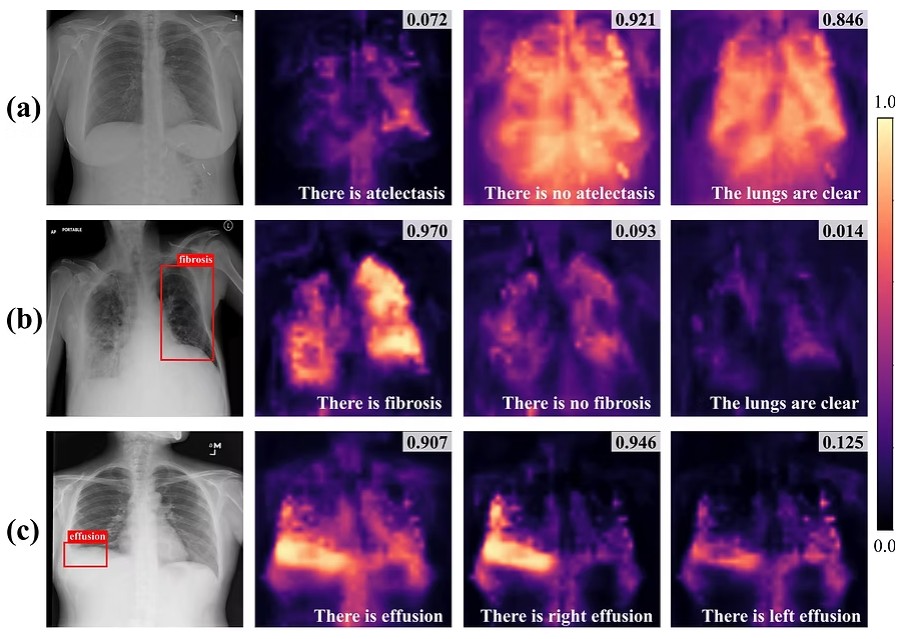
Photo 1. A vision-language model learns the relationship between chest X-ray images and radiology reports and expresses their similarity as probability values
- RadZero, an innovative technology for AI-assisted interpretation, earns international recognition for the importance of explainable AI interpretation
- Applied to M4CXR, a draft report generation solution for chest X-ray, now in a multicenter clinical trial
- “We expect M4CXR to help improve diagnostic efficiency and accuracy in real clinical settings once commercialized”
DEEPNOID, one of Korea’s first-generation medical AI companies (CEO Woo Sik Choi), announced on September 23, 2025, that its research team’s paper on RadZero, a chest X-ray image analysis technology, has been accepted at NeurIPS 2025 (Conference on Neural Information Processing Systems), a leading international AI conference.
NeurIPS is one of the world’s most prestigious conferences in AI. Each year, about 20,000 papers are submitted from around the world, and only about 25% are accepted after rigorous review. The acceptance shows that RadZero, developed by DEEPNOID, has earned international recognition for its academic excellence and innovation. The research was conducted entirely by DEEPNOID’s research team (Jonggwon Park, Kyoyun Choi, Byungmu Yoon, and Soobum Kim), demonstrating the company’s independent technological capabilities and research competitiveness.
The research team will present its findings in San Diego, USA, in December 2025. RadZero is a core technology of M4CXR, DEEPNOID’s multimodal generative AI-based medical device. It is a framework with vision-language-based zero-shot multi-task capabilities that breaks radiology reports down into minimal semantic units and precisely aligns them with X-ray images.
This enables RadZero to support:
- High-resolution image processing
- Zero-shot classification, which recognizes lesions not included in the training data from text alone
- Segmentation, which marks lesion areas at the pixel level
- Visual grounding, which links text descriptions to locations in the image
RadZero’s biggest innovation is its significantly improved explainability, meaning its ability to show the basis for AI interpretation. Using its in-house Vision-Language Cross-Attention Based on Similarity (VL-CABS) model, RadZero can more clearly explain why a given text is linked to a given image region. Clinicians can intuitively check the basis for AI interpretation results, which greatly increases trust in AI technology in clinical practice.
RadZero was evaluated on four zero-shot multi-task capabilities across eight public benchmark datasets, achieving state-of-the-art (SOTA) performance across classification, grounding, and segmentation tasks.
In particular, RadZero performs classification, segmentation, and grounding simultaneously without separate labeling, which is time-consuming and costly. It can also handle rare diseases that are seldom encountered in clinical practice, so it is expected to complement existing training methods for medical imaging AI.
“The acceptance at NeurIPS confirms the importance of explainability in medical AI and is international recognition of DEEPNOID’s vision-language model technology,” said Jonggwon Park, Team Lead of AI Advanced Technology at DEEPNOID. “We expect M4CXR, which incorporates RadZero, to be commercialized and applied in real clinical settings, helping improve diagnostic efficiency and accuracy.”
In August 2025, Korea’s Ministry of Food and Drug Safety (MFDS) approved the clinical trial plan for M4CXR as a digital medical device. As of September 2025, DEEPNOID was validating the clinical effectiveness and safety of M4CXR through a multicenter, retrospective, confirmatory clinical trial with Kangbuk Samsung Hospital and Boramae Medical Center.
###